MARMOSET VOCALIZATION IS CLOSER TO HUMANS THAN TO OLD WORLD PRIMATES (CHIMPS AND MACAQUES)
Evolutionary Convergence of the Arcuate Fasciculus in Marmosets and Humans
Wang, Yufan, Luqi Cheng, Deying Li, Yuheng Lu, William D. Hopkins, Chet C. Sherwood, Ting Xu, Cirong Liu, George Paxinos, Tianzi Jiang, Congying Chu, and Lingzhong Fan.
Abstract
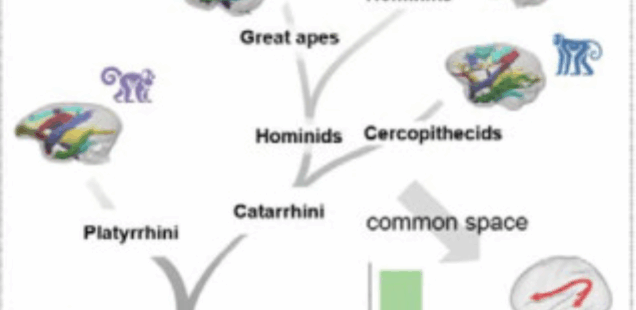
The marmoset is a highly vocal platyrrhine monkey that shares key anatomical and functional features with humans, offering insights into the evolution of brain connectivity. Although similarities in vocalization features with humans have been reported, it remains unclear whether marmosets possess an arcuate fasciculus (af) homolog. This study delineated white matter tracts in marmosets, establishing homologies with those observed in other primates, including macaques, chimpanzees, and humans. The presence of an af homolog in marmosets was confirmed by tracer and ultra-high-resolution diffusion magnetic resonance imaging datasets. We compared cortical connectivity patterns across these species and found the af in marmosets terminates in the ventral frontal cortex, with greater similarity to humans than macaques. Furthermore, we linked af connectivity with vocalization-related brain activation in both marmosets and humans. Collectively, our findings suggest that a dorsal pathway, which emerged early in marmoset evolution, has evolved convergently with humans, despite their distant phylogenetic kinship.
https://pmc.ncbi.nlm.nih.gov/articles/PMC12262616/